Ethiopia - Ayla Shentawane
MILK CHOCOLATE. TOFFEE. BLUEBERRY. RAISINS
ROAST: Light
- Regular price
- €14,00
- Sale price
- €14,00
- Regular price
Basic Information
Basic Information
Grind of the coffee
Your coffee can be grounded according to your needs - from coffee beans, to espresso grinds, to filter grinds. Please specify how your coffee would be prepared and we will grind it for you.
Grind of the coffee
Your coffee can be grounded according to your needs - from coffee beans, to espresso grinds, to filter grinds. Please specify how your coffee would be prepared and we will grind it for you.
Couldn't load pickup availability


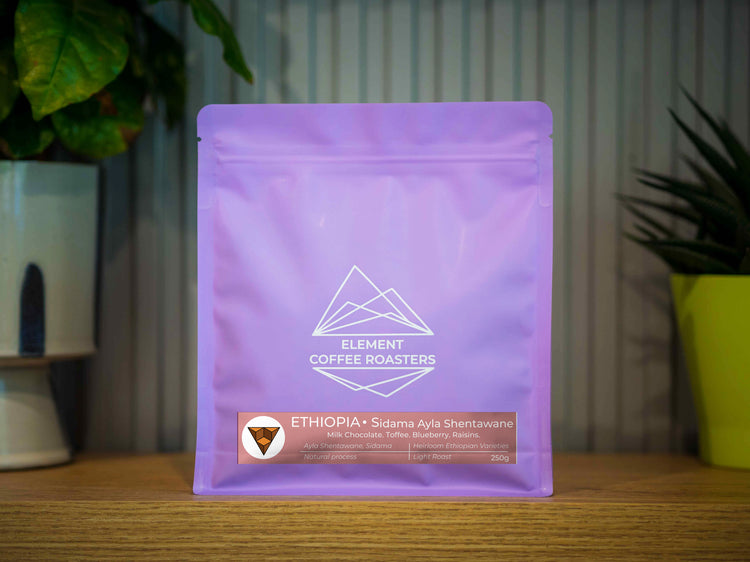
More about Ethiopia - Ayla Shentawane
Description
More
Less
The Ayla Washing Station, situated in the village of Shantawene within Ethiopia's Sidama region, is a notable hub for specialty coffee production. Operated by Testi Coffee, a family-owned enterprise founded by Faysel A. Yonis, Ayla is one of several stations under their management, processing coffees from nearby villages including Bombe and Shentawane.
Coffees in Ethiopia are typically grown on very small plots of land by farmers who also grow other crops. The majority of smallholders will deliver their coffee in cherry to a nearby washing station or central processing unit, where their coffee will be sorted, weighed, and paid for or given a receipt. Coffee is then processed, usually washed or natural, by the washing station and dried on raised beds.
The washing stations serve as many as several hundred to sometimes a thousand or more producers, who deliver cherry throughout the harvest season: The blending of these cherries into day lots makes it virtually
impossible under normal circumstances to know precisely whose coffee winds up in which bags on what day, making traceability to the producer difficult.
Country and Region Heirloom Ethiopian Varieties
More
Less
Process: Natural
More
Less
Variety: Heirloom Ethiopian Varieties
More
Less
Description
The Ayla Washing Station, situated in the village of Shantawene within Ethiopia's Sidama region, is a notable hub for specialty coffee production. Operated by Testi Coffee, a family-owned enterprise founded by Faysel A. Yonis, Ayla is one of several stations under their management, processing coffees from nearby villages including Bombe and Shentawane.
Coffees in Ethiopia are typically grown on very small plots of land by farmers who also grow other crops. The majority of smallholders will deliver their coffee in cherry to a nearby washing station or central processing unit, where their coffee will be sorted, weighed, and paid for or given a receipt. Coffee is then processed, usually washed or natural, by the washing station and dried on raised beds.
The washing stations serve as many as several hundred to sometimes a thousand or more producers, who deliver cherry throughout the harvest season: The blending of these cherries into day lots makes it virtually
impossible under normal circumstances to know precisely whose coffee winds up in which bags on what day, making traceability to the producer difficult.
Country and Region Heirloom Ethiopian Varieties
Process: Natural
Variety: Heirloom Ethiopian Varieties
You May Also Like
More about us on social media