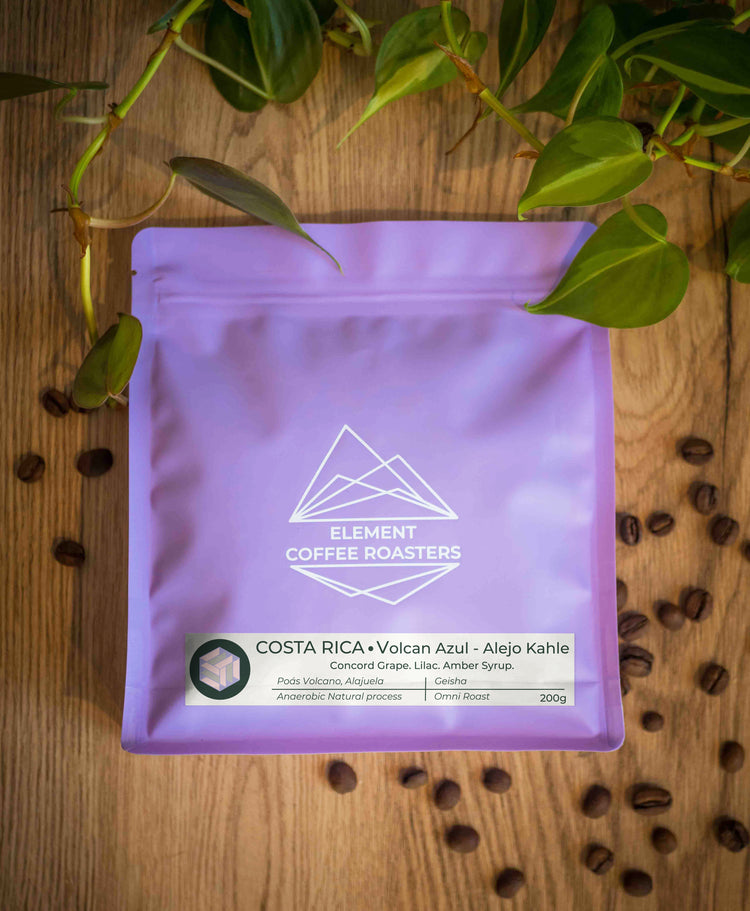
Costa Rica Volcan Azul Geisha - Alejo Kahle

CONCORD GRAPE. LILAC. MAPLE SYRUP.

ROAST: Omni

Regular price
€20,00
Sale price
€20,00
Regular price
Tax included. Shipping calculated at checkout.
Size:
Grind:
Detailed Information

More about Costa Rica Volcan Azul Geisha - Alejo Kahle

Description

The Volcán Azul farm is a pioneer in sustainable agriculture and traceability of the coffee microlots.

The coffee from Volcán Azul farm, situated on the slopes of the Paos volcano in the Alajuela region, is grown in cool climate at an altitude of 1500 - 1700 meters in volcanic soils, that are rich in minerals. This gives the coffee beans pronounced delicious acidity, complex aroma profile and clear distinctive cup.

Volcán Azul farm is known for its experimental growing and fermentation techniques, used for growing coffee varieties such as Caturra, SL28, Gisha, which are processed via washed, natural or anaerobic processes.

Country and Region Geisha

As the first Central American country to fully establish a coffee industry, the history of coffee in Costa Rica is long and full of great economic significance. Coffee was planted in Costa Rica in the late 1700s but it was not until the 1820s that coffee became a major agricultural export for the country.

West Valley—known for its high percentage of Cup of Excellence winners—grows an abundance of both the Costa Rica–specific varieties, as well as some of the more “experimental” varieties as a result from the fact that coffee producers have become increasingly interested in using variety selection as another way to stand out in the competitive market. Valley has some of the most distinct weather patterns in the country, with well-defined wet and dry seasons where some of the best natural processed coffees in this region can be found.

Process: Natural Anaerobic

Freshly harvested and sorted cherries are delivered to the mill and promptly depulped. After this, the coffee is placed directly onto raised beds for a few days and then transferred to a covered patio where it is turned regularly until the drying process is complete.

Variety: Geisha

A rare and expensive variety, highly-sought for its delicate floral and fruity tasting notes.
There are two primary genetic strains of Gesha (1931; 1956), that are both are derivative from the Ethiopian varieties collected
by the British in the 1930s.

Description

The Volcán Azul farm is a pioneer in sustainable agriculture and traceability of the coffee microlots.

The coffee from Volcán Azul farm, situated on the slopes of the Paos volcano in the Alajuela region, is grown in cool climate at an altitude of 1500 - 1700 meters in volcanic soils, that are rich in minerals. This gives the coffee beans pronounced delicious acidity, complex aroma profile and clear distinctive cup.

Volcán Azul farm is known for its experimental growing and fermentation techniques, used for growing coffee varieties such as Caturra, SL28, Gisha, which are processed via washed, natural or anaerobic processes.

Country and Region Geisha

As the first Central American country to fully establish a coffee industry, the history of coffee in Costa Rica is long and full of great economic significance. Coffee was planted in Costa Rica in the late 1700s but it was not until the 1820s that coffee became a major agricultural export for the country.

West Valley—known for its high percentage of Cup of Excellence winners—grows an abundance of both the Costa Rica–specific varieties, as well as some of the more “experimental” varieties as a result from the fact that coffee producers have become increasingly interested in using variety selection as another way to stand out in the competitive market. Valley has some of the most distinct weather patterns in the country, with well-defined wet and dry seasons where some of the best natural processed coffees in this region can be found.

Process: Natural Anaerobic

Freshly harvested and sorted cherries are delivered to the mill and promptly depulped. After this, the coffee is placed directly onto raised beds for a few days and then transferred to a covered patio where it is turned regularly until the drying process is complete.

Variety: Geisha

A rare and expensive variety, highly-sought for its delicate floral and fruity tasting notes.
There are two primary genetic strains of Gesha (1931; 1956), that are both are derivative from the Ethiopian varieties collected
by the British in the 1930s.

You May Also Like

More about us on social media

In our social media account, you can find more stories from us and some exciting news.